Polarizing Beam Splitter (PBS)
A Polarizing Beam Splitter (PBS) is typically formed by cementing or optical contacting the hypotenuse faces of two right-angle prisms. A polarizing beam-splitting coating is deposited on the inclined..
Product Description
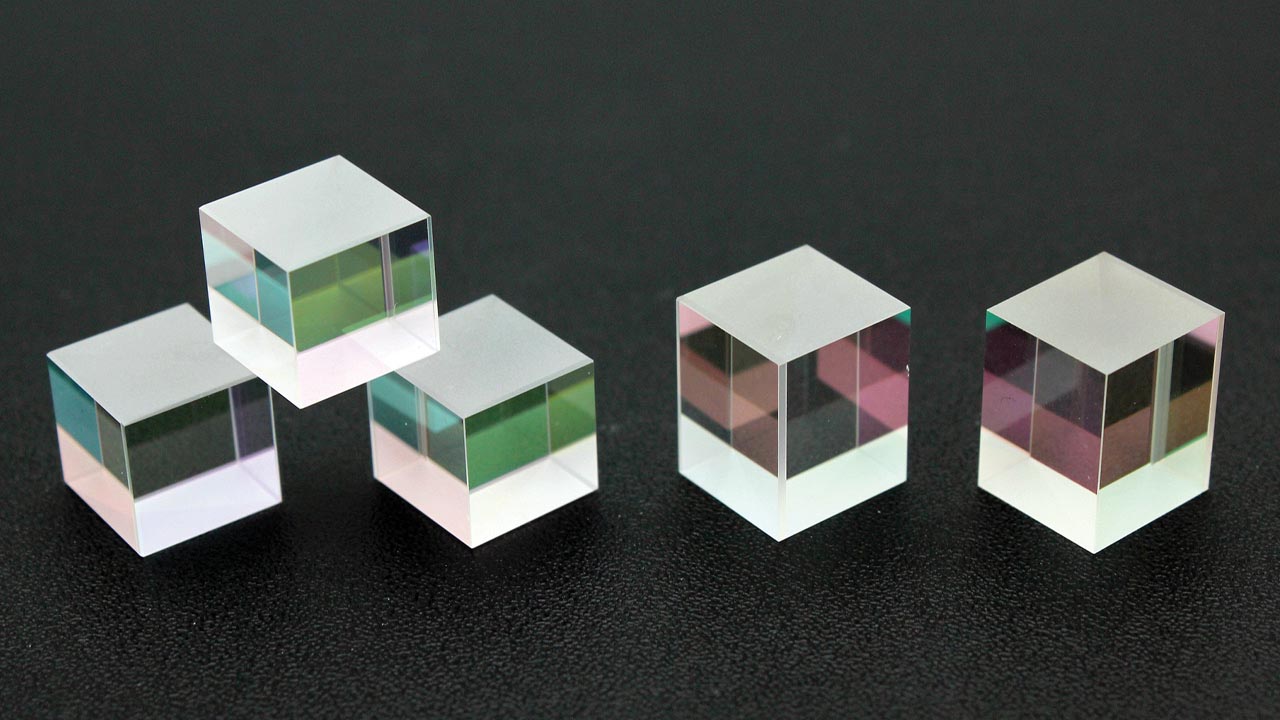
A Polarizing Beam Splitter (PBS) is typically formed by cementing or optical contacting the hypotenuse faces of two right-angle prisms. A polarizing beam-splitting coating is deposited on the inclined surface: P-polarized light in the incident beam is transmitted, while S-polarized light is reflected. Anti-reflection coatings are generally applied to all beam entrance and exit surfaces.
| Project | Performance Parameters |
| Material | K9, Fused Silica, ZF Glass |
| Specifications | 3*3*3, 5*5*5, 8*8*8, 10*10*10, 12.7*12.7*12.7, 25.4*25.4*25.4 (unit: mm, clear aperture customizable) |
| Dimension Tolerance | ±0.05 mm |
| Extinction Ratio | Single wavelength > 2000:1, Broadband > 1000:1 |
| Surface Quality | 10-5 |
| Beam Deviation | 3' |
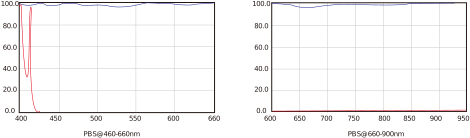
| Coating | Single wavelength: 780, 850, 980, 1030, 1064, 1310, 1550 nm Broadband: 450-650, 650-900, 900-1200, 1200-1600 nm High damage threshold: 15 J/cm², 10 ns, 10 Hz @1064 nm |
Single-Wavelength High-Power PBS
| High Damage Threshold | ~15 J/cm² @1064 nm, 20 ns, 20 Hz |
| Extinction Ratio | > 30 dB @1064 nm |
| Transmission | Tp > 97% @central wavelength; Tp > 96% @355 nm |
| Surface Quality | 20-10 |
| Standard Wavelengths | 1064 nm ±20 nm (BK7), 1550 nm ±25 nm (BK7) 532 nm ±20 nm (BK7), 355 nm ±7 nm (Fused Silica) |

Broadband High-Power PBS
| High Damage Threshold | > 3–5 J/cm² @1064 nm, 20 ns, 20 Hz |
| Extinction Ratio | > 30 dB |
| Beam Deviation | < 3 arcminutes |
| Average Transmission | Tavg > 92% |
| Surface Flatness | λ/4 @633 nm |
| Surface Quality | 40-20 |
| Standard Wavelength Ranges | 450-650, 650-900, 900-1200, 1200-1600 nm |